Wednesday, November 7, 2012

Al-Jordan

We spent 6 days in Jordan during the first week of October at the time of the Mid-Autumn Festival holidays in Hong Kong.

  • Day 1: Arrive Amman from Dubai. We stayed at Hotel Hisham, a quaint and quiet boutique hotel in the Embassy quarter near the 3rd circle
  • Day 2: Half day in Jarash and half day in Amman on a private sightseeing tour. In Amman, we drove through new (wealthy) neighbourhoods and visited the Citadel and the Roman Amphitheater
  • Day 3: Self Drive to Petra via Mt Nebo, stayed at the Seven Wonders Bedouin camp in Little Petra, a unique desert experience
  • Day 4: Sightseeing in the Petra Siq, including The Treasury, The High Place of Sacrifice, Wadi Farasa, and finally the monastery or Ad-Deir
  • Day 5: Day trip to Wadi Rum, night stay at the Movenpick Hotel in Petra
  • Day 6: Petra to Dead Sea, return to Amman
  • Day 7: Fly from Amman to Dubai
This itinerary seems about right for Jordan. Perhaps one extra day can be spent at Petra exploring Little Petra in more detail. One night at the Bedouin camp (shared toilet facilities!) is probably the most one can take if you are not used to backpacking. Wadi Rum is intensely beautiful, and a night in the desert can be a fascinating experience too. Reserve a whole day for the Dead Sea experience, which closes pretty early in the evening.


Overall impressions: Landscape is pretty stark. No trees or shrubs or flowers. All houses seem stucco whitewashed. Due to mountainous terrain, good panoramic views are possible. People tend to follow late lunchtimes and dinner times. The day we landed in Amman we tried to find lunch at 11:30am and were turned away by most places. Restaurants come into their own at dinnertime, otherwise are quite empty. Although October is technically tourist season, it seemed tourist arrivals are slow. Most places seem rather quiet. Food is very vegetarian friendly. Similar to Lebanese cuisine. Lot of vegetarian starters and almost all the mains are meat based.
History: In the middle of the Biblical region, has the influence of Greek, Roman, Islamic cultures. Earliest recorded is the Nabatean tribe around 538BC, then Greek and Roman. Then Umayyads in 661AD with Damascus as capital. The Frank Crusades from 1095AD (and hence the origin of the word “franj” in Arabic, meaning Westerner, similar to “firang” in Hindi). The Ottomans ruled from from 1520AD and the Hashemite Kingdom of Jordan was created in 1947.

Highlights:

Jarash: saw the ruins which have been largely influenced by Roman styles and Greek gods. The long street running through the forum, called Cardus Maximus is quite stunning for its fine colonnades and cobblestones with chariot ruts, and ruins of temples and churches alongside rather well preserved. To imagine walking over the stones that still had chariot ruts from 2000 years ago was a very special feeling. Jarash was a town large enough to have two amphitheatres, both of which are still in rather good shape.
Our entry ticket for the Jerash site

Citadel and Roman amphitheater at Amman: interesting how some part of every dynasty is represented including c2500BC burial mounds. Not many traces of the ancient Greek city called Philadelphia. The notices are quite self explanatory as to which period the particular piece/structure belonged. Of all the places we visited in Jordan, this site had the best signage - perhaps the perks of being in the capital city. We visited the popular tradition museum which is accessed through the Roman Theatre: the collection is average, but since it doesn’t take much time, it is worth a quick look-see – the traditional dresses of the people in the region are the most interesting to see.

The entry ticket for the Roman Theatre in Amman
Mount Nebo: can easily be missed in favour of any other sight. On a clear day apparently you can see Jerusalem on the other side of the Dead Sea. When we visited, things were so foggy we could not even see the Dead Sea. Nonetheless, Madaba and Mt. Nebo are rather different from the rest of Jordan due to the large Christian minority that has settled here. Famous is the Madaba mosaics: very interesting pieces of art that developed from 4th century onwards when Christianity gained a strong hold. Together with the Baptism Site and the Dead Sea, they form the main Biblical sites in Jordan.
The entry ticket to the Mount Nebo site has a tiny picture of a Madaba mosaic


Petra: Walking through the narrow Siq to be suddenly confronted with the monumental façade of the Treasury is a must-have experience. The size and scope of the siq and how well preserved some of the monuments are gives the tourist a good glimpse into history. The rocky ascent to the Ad-Deir or monastery is enervating but a must-do. Really awe inspiring to see how the monuments are cut into the rock. A full day starting as early as you can is a must. Some people do 1.5 days to space it out. Lunch at the Collonade Cafe neatly divided the day into the first half (siq, Treasury, High Point of Sacrifice) and second (Ad-Deir). The restaurant managed by the Crowne Plaza Hotel (we think its called The Basin) is worth missing. Many people use donkey and horse-carriages to be taken around in Petra, but our suggestion would be to do it with your own two feet.

Jordanian beer
You can buy 1 or 2-day tickets for the Petra site
 

Wadi Rum: We unfortunately did not see sunrise or sunset here which is supposed to be magical. Nonetheless, after the imposing and magnificent facades that are manmade, the sheer beauty of the wild and natural formations in Wadi Rum are an inspiring contrast. Definitely a must-do. We drove in a battered, but-no-different-from-the-rest 4x4 around the Rum for 5 hours stopping at a Bedouin camp for lunch and a climb of one of the bridges were some of the highlights of the day. We felt that 5 hours was a bit much given the blazing relentless glare of the sun, but definitely 3 hours is do-able. Climbing the Burdah rock bridge before dawn is supposedly a highlight, but we only saw it from afar. Some of the prehistoric inscriptions on the rocks are very interesting. Our conversation over lunch with our Bedouin host was remarkable. Here was a man who had never left the desert, but could speak Arabic, English and even French. He had no access to TV, newspapers or even radio, and yet could discuss the fact that there was global financial crisis on. And you could see contentment written all over his face... he was a man of the desert... all he wanted to do was be there and look after his camels.
The entry ticket to the Wadi Rum conservation area shows the Seven Pillars of Wisdom

Dead Sea: We thought we would make a day’s trip to the Dead Sea on our way back to Amman from Petra. Didn’t realize that we should have probably booked a hotel resort in advance. By the time we reached the resort it was 4:30pm, and there were no bookings available, or else the price-value of the offering was not working out. Unfortunately we didn’t get to float in the Dead Sea, and decided to leave it for later as part of a potential trip to Israel.


Recommendations

Fakhr El-Din: Syrian / Lebanese cuisine in Amman. Advance reservations can get you outdoor seating. Housed in an elegant 1920s villa, and attracts the royalty and the elite. Lots of vegetarian hot and cold mezzes and salads. Very famous establishment - so all you need to do is get into a cab and ask the driver to take you there. Incidentally, it is located two lanes behind the Iraqi Embassy.

Al-Saraya: In the Petra Movenpick, well presented and delectable Arabic cuisine including cold and hot food. The eggplant was particularly flavourful.

Rajeen: On Rainbow Street in Jabal Amman, just off the 1st Circle is this wonderful restaurant offering classic Jordanian and Lebanese fare. The beetroot moutabbel was particularly delightful!

al-Aydi Crafts shop: This store is a hidden gem. Situated quite centrally near the 2nd Circle, it contains a variety of handicraft items to browse and buy. The range includes fabric and clothes, jewelry, decorative pieces, ceramic and glassware, and bronze / brassware too!

The Green Valley Restaurant & Camp; Rest House: Located in Jerash on the highway to Amman, this place provies delectable local cuisine at just the right time when you have begun to feel tired after a visit to the ruins of Jerash. The biggest bread we had in Jordan was served here.


The Places We Stayed At

Amman: Hisham Hotel   www.hishamhotel.com.jo

Petra: Seven Wonders Bedouin Camp   www.sevenwondersbedouincamp.com  Spending the evening around the communal campfire and talking to the other visitors from all around the world was a very good experience. The hospitality of our Bedouin hosts was remarkable. They helped us arrange the guide and trip to Wadi Rum too.

Petra: Movenpick Resort   http://www.moevenpick-hotels.com/en/middle-east/jordan/petra/resort-petra/overview/

And Our Pictures

Jerash, Amman & Mt Nebo

Petra, fantastic Petra

Awesome Wadi Rum


To view our other travelogues, please visit our Wanderlust page.

Thursday, October 13, 2011

A Bali High!

After over 13 years in Hong Kong, we managed a trip to Bali for the first time, and managed to coincide it with our wedding anniversary.

Beautiful Bali, exotic Bali, wonder why we never managed to see it before! But now we are firm fans: definitely a placed we’d go to again and again. For those who are considering Bali as a holiday destination, we hope we can present a balanced opinion to help you make up your mind. For those who know Bali like the back of their hand, hopefully our experience will resonate with you, and perhaps you have more to share. Do tell!

The Rant (we'll keep it short): Bookings were a total pain. Maybe due to the Golden Week in China, but we just could not get decent direct connections from Hong Kong, instead having to fly via Singapore. To be avoided if possible, because it adds a whole 2 days to your trip. We flew HK-Singapore-Denpasar on 5th October, and returned on 10th, which gave us 4 whole days in Bali, and brief transits at Singapore Changi Airport.

And now... the Raves
We were adamant about staying in Ubud, which is in the interiors of Bali island – this is because we prefer forests and farmland over beachfronts and bikinis. Strangely, it seemed everyone was thinking like us: we were getting bookings at various beach resorts like Jimbaran, Kuta, Nusa Dua and Seminyak but not at Ubud. Had to settle for the only one available, Furama Villas. Nice property and facilities, but not so nicely maintained. We landed at Denpasar late evening, and took an hour to transfer to the hotel, which we reached at 10:30pm.

5 days - 5 experiences!
Next day, we decided to take it really easy, and spent most of the morning at the hotel exploring the villa and its limited food options. In the afternoon-evening we took the villa shuttle to Ubud town which was around 30 minutes away, returning after dinner, plus two umbrellas hastily purchased to shelter from a downpour. This was like a welcome shower, weather otherwise was fantastic all the way through: warm and salubrious in the mornings, nice and nippy in the evenings.

Day 2 and Day 3 were the “active” days. Obviously the word is very relative - given our somnolence and reluctance to even lift a finger or a toe towards any extra effort, this was itself a big deal. On Day 2 we drove… and drove… and drove to the north east of Bali towards the volcano and Batur Lake at Kintamani. The destination itself was nothing to write home about, but it gave us a good opportunity to get a feel of the place.

We also saw the Goa Gajah (or elephant cave) temple – probably one of several similar temples dotted around the island – goa or gua is like “Guha” or cave, “Gajah” is elephant like in Sanskrit.

On Day 3 we drove in the opposite direction towards the south west, first to Uluwatu temple and then to the seaside temple at Tanah Lot, passing by various beaches on the way.

Day 4, our anniversary, was a lazy one. After a nice morning walk on the village roads surrounding our villa, we had a long slow spa session followed by lunch. Evening was Ubud village for some shopping, followed by a leisurely dinner at Café des Artistes.

Day 5 we spent all the day flying back home after a short but lovely and leisurely holiday.

Here are some of our observations.

Flower Power
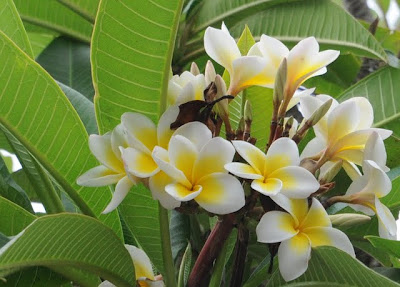
The Balinese use of flowers is high and innovative. Frangipani is everywhere: both real and in paintings, and define Bali almost. They adorn steps in a neat arrangement, or women’s hair, or sometimes playfully tucked behind the ear of statues, or even left “accidentally” around on the pillow, in the shower area or on the towels!

Here's a picture from Uluwatu Temple


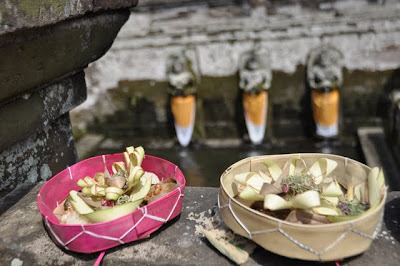
Very evocative of an exotic Asian feel, the stuff novels are made of! Flowers are also put together on a betel leaf like leaf and placed as offerings to gods, outside houses/temples. Somewhat similar to the role played by rangoli in India.

From A Bali High!

Long and Narrow are the Roads in Bali
Didn’t realize Bali was so spread out until we actually experienced it. Friends had warned of traffic, but we were still shocked by the reality of it. If there is one thing that may work against visiting Bali, this has got to be it – distances feel longer than they are, and traffic is painful, so I predict our repeat visits if any will end up being even more comatose and restricted to the area immediately around our lodgings. Narrow roads and frequent traffic jams mean that average speeds are very rarely above 40 kmph, and a relatively small island suddenly begins to feel large! The saving grace is that there is no horn-abuse!

Check out the map of Bali - doesn't it look like a Kiwi bird?


From A Bali High!
We were fortunate that our driver was as laid back as we were. Sukra Wiguna has a car and is more than willing to drive you around. He is soft spoken and knowledgeable and it was good to have him drive us.  Thanks, Pushkar and Bashuli for getting us in touch with him. Sukra also told us about his dreams and ambitions: he is on the verge of opening a shop that sells Chinese style dessert and he wants to visit India. We hope his dreams are fulfilled.  Sukra may be contacted at +62 819 1732 4070.

Are you from India?  Are you Hindu?
There were so many things which were comparable to the known and familiar in India! Temple and building architecture for example – the gods were quite familiar. Typically Ganesh or Vishnu. The layout of the temple included shrines to several gods, but always had nine pillars probably corresponding to our navagraha (नवग्रह). The grey and burnt orange combinations were beautiful; I could even imagine a sari with that combination. Most of the temples are still in use. We got the sense that almost every other road or village had a temple, there were so many littered around Ubud. One difference was the Balinese’ endearing treatment of their statues, just like humans, most of them are clothed! Typically black ‘n white check sarong called the poleng, which is supposed to be holy.


From A Bali High!

A majority of Balinese were very happy to hear we were Indians and Hindu, as are they. Of course, the definition of Hindu / Indian varies quite widely, depending on the person spoken to. Some think it is devotion to Sai Baba, others have deified Bollywood actors Shah Rukh Khan and Amitabh Bachchan! As you may imagine, epic movies like “Asoka” enjoy a wide viewership here. Familiarity with the Gods’ names is very high however. Statues of Garuda / Hanuman / Ram / Ganesh are routine to them, but magnificent and unique tous! Highlight was that we even saw silver finger rings of Ganesha in the shops.What was most curious to us though was the apparently casual style of shopkeepers in stocking hoards of stone statues outside their shops even overnight: no lock and key! Either they are so invaluable or the level of honesty in Bali is high, or maybe the laws of demand and supply are very lopsided towards net high supply (this is our theory). Felt rather ghostly to drive through this area at night – a whole street of ghostly personalities standing motionlessly in a challenge to time.

Vegetarian?  Yes, we have!
A number of Balinese are almost veggie but eat fish. Our driver, Sukra, also informed us that the most common meat in Bali was pork!  For us though, vegetarian food was no problem at all, though in most cases, it defaulted quickly to the lowest common denominator of nasi goreng or sayur lodeh or nasi sayur. Sayur is the word for vegetarian.

We enjoyed most of our meal experiences. Among other places, we ate at some of these restaurants and would be happy to go back for another bite:
  • Miro's Garden Restaurant, Ubud                    www.mirosbali.com
  • Bebek Bengil - Dirty Duck Diner, Ubud
  • Cafe Lotus, Ubud                                            www.cafelotusubud.com
  • Cafe Des Artistes, Ubud                                 www.cafedesartistesbali.com
  • Ketupat, Kuta                                                 www.ketupatrestaurant.com
It was interesting to see that many restaurants have huge garden areas with open air dining around a courtyard towards. When the weather is good, it can make for an even better dining experience!

Have Land, Will Use!
What was striking and quite charming was the strange juxtaposition of various things all together. For instance, a temple right outside the villa we stayed at. Or, farmland in the middle of civilization. And a Painting gallery in the middle of  an industrial park. Though of course, we did see entire streets (and even villages) with art galleries, or ones with stone statues, or others with jewellery as artisans of a particular trade are wont to gather together in an area. We wondered at the efficiency of such town planning, though charming to the beholder.
No matter what the land was used for in any village, there would always be temples. And from somewhere in the background would come the faint sound of flutes. We did observe much less of this once we were outside the Ubud area... and in the more urban parts of the island (eg, Kuta, Jimbaran, Denpasar, Seminyak), temples were few and far between.

And all over Bali, it was a common sight to see the people make offerings (canang sari) in front of their homes or shops on a daily basis. Small baskets made of pandanus leaves with tiny portions of cooked rice, flowers, and others things make up a typical canang sari.

Ubud Writers & Readers Festival:
We were quite surprised by this fairly significant event that was taking place at the same time. Indeed, we think this could be the reason why hotels were running so full in the Ubud area. This festival seems to be a fairly well known one, somewhat like the one in Jaipur every year. Like most other literary festivals, they had a number of venues, and a number of visiting authors and the glitterati of literati. All seemed to require bookings in advance so we couldn’t take advantage of it, but in our minds, we thought this could be something for our Literary Group to do at some point in the future.

We loved the logo of the festival too...

Shopping
There's lots to browse and buy. Around Ubud, the cultural capital of Bali, there were shops, streets and villages that sold handicrafts, statues, furniture in wood and rattan, paintings, batik, silver and gold jewellery.  In Ubud town itself, Monkey Forest Street is a good option for retail therapy.

Moneychangers
Moneychangers can be found all over the place. But be careful of where you exchange your $ for Rupiah to ensure that you don't get counterfeit currency palmed off to you. Also, rates vary - so its good if you scan the street before you swap. We were happy with Pt Dirgahayu Valuta Prima (www.balibestrate.com).

Sanskrit roots
It was very interesting to observe the use of words in Balinese and Bahasa Indonesia that are derived from Sanskrit.  Here are a few examples:
  • Monkey Forest: Wenara Wana: वानर वन
  • Glass: Kaca: काँच
  • Health: Sehat: सेहत
  • Language: Bahasa: भाषा

What we didn’t do this time (but would like to do next time)
  • Beaches
  • Dances (erm... not the ones on the beach, but the traditional dances that Bali is famous for)
  • Hikes
Pictures
Check out all our pictures!

Sunday, November 15, 2009

Turkish People

Turkish people are really cool. First of all, they look so different from each other. Secondly, there is this exotic blend of the east and west: are they European, are they Asian? Secondly, they are very aware of the world outside their shores, which is rather unusual. For instance, Vix and Vinoo attracted a lot of attention due to the star they had on their caps (sourced from Shanghai Tang). People used to inevitably stop them with the enquiry as to whether they are communist. And the relationship was not tracked back to China but Cuba! According to them China is not communist, its rank capitalist! (Try saying that to President Hu) And then there would be a big discussion around the history of communism, the religion of Indians, and the connection between Turkey and India through the silk route, et al. Very informed people.

What was most interesting was that they were so chill that they would take the time to talk to you. After getting used to Hong Kong, where time is evaluated in money terms, this was refreshing and reminiscent of an older more halcyon era where people communicated with each other rather than with their blackberries. Their sense of humour is fantastic. Makes business transactions such a pleasure. Fully enjoyed our spice buying session in a shop in the Spice bazaar, and trinket buying in the Grand Bazaar! The shop owner in the Grand Bazaar told us a lot of stories of his experiences in India (he goes once in 6 months to buy gems from Jaipur), and actually took out his passport and showed us the stamps. Also gave us a crystal bracelet each for good luck after we had concluded the sales. Of course that makes you wonder whether he overcharged you so much that he threw in the bracelets for free out of guilt! That’s the only thing I personally don’t like about Turkey: they love to bargain, and everything must be negotiated. Which always leaves you wondering whether you’ve been taken to the cleaners in every transaction…

Turkish cats and dogs and their interactions with people

Turkish cats and dogs seem to be very much like the Turkish people, exotic, of all kinds, quite laid back, playful/humorous, and very friendly. We had the good fortune of interacting with them in a family setting in Cappadocia in the hotel where we stayed, whose hosts managed a menagerie of different dogs and cats. This was the first time we saw these animals actually having a “personality”! there was a Garfield cat which lay around oblivious to all that was going on around him, but was not at all averse to putting out his paw to take your food unless you showed him a hand and said “no” rather forcefully. Then there was a dog (pup really) – all he wanted to do was to play with the cats but the cats were acting coy and deliberately irritating the dog by jumping and whirling from pillar to post. Vix had this strange thought at the time: wouldn’t it be a disaster for a cat that had agoraphobia and a fear of jumping!!! Then there was another cat that played football with us for a whole hour. We would throw a wine cork at her, and she would bound after it and kick it back to us! And then the cork would go under a heavy cupboard, she wouldn’t mind flattening herself to get underneath to retrieve it! And there was this really unwell cat: she was breathing like she had asthma and then we learned she died that night. So sad. We also met a cat in one of the shops – all she wanted to do is to rub herself against anyone’s legs that would let her, purring all the while. I don’t normally like cats, but Turkish cats were a delight. An animal lover’s paradise.

Turkish Hammams

Didn’t know what to expect, but we were told that hammams (Turkish baths) were staffed by these massive topless women who (wo)manhandled you and treated you like a piece of cloth: washed you very well but made you feel like a rag while doing so. We didn’t have much time except in our hotel in Kappadocia where the ladies decided to try it out. . The reality was very different. First of all, it was quite unnerving to walk into the spa and when asking for a masseuse, to be confronted by a man all ready to service our request! After insisting upon a “for women, by women” kind of framework, we got to the next step - stripping and wrapping ourselves in a scrap of cloth - with tassels! Pray why the style in a bathroom??? Did nobody tell them that its coverage we want, not fashion?? We almost sashayed out of the changing rooms only to find the aforesaid male masseuse lurking around. A few hurried pidgin Hindi internal confabulations later, we banished this poor male from his own hammam before we were ready to walk out like queens. The point at which we gave up and were bent into submission was when we walked into the sauna and found it to be co-ed!

After that it was totally easy. If you can philosophise that everyone has the same bits and bobs, you can be ready for anything. But not male therapists please! Anyway, we first baked ourselves in the sauna in the attempt to “open our pores”, then lay on a slab of marble like a piece of meat waiting to be scrubbed clean. The “madam” of the hammam (hamster?) was a totally petite and svelte young thing, completely different from what we were told to expect. Wondering whether that made the difference: wasn’t exactly painful or invigorating, or anything at all. We did feel like we were the laundry though when we got a whiff of the familiar laundry detergent that they put in tonnes onto our body, and scrubbed us with a loofah like a veggie! Incidentally all the bazaars carry such a variety of bath sponges, its like you can decide the quality, pressure, and shape of the rub you want on any day! Have to say that managing the tassled bath robe in this situation makes you ready for any costume changing challenge! And we did look suitably “chastened” and clean when we dripped and hopped our way into the changing room.

Thursday, October 22, 2009

HIstorical Istanbul

On Monday morning, October 19 2009, Vishanj arrived in Istanbul from Dushanbe. And Vishanj and Vixabs met for the third time this year! And no sooner had we met, we began to make plans for the rest of the day. And as usual, our plans were over-aggressive!

We took a taxi to the Sultanahmet area. Over there, after crossing the Arasta Bazar, we walked inside the famous Blue Mosque. Inside the walled enclosure, there was a big courtyard where we waited briefly for the prayer time to get over before walking in. The mosque is HUGE! Stained glass windows adorn its upper layers and vie with hand-painted tiles in blue patterns for our attention. Long steel wires run all the way from the domes that on the cieling of the mosque to just a little higher than human height. From these steel wires are suspended chandeliers and stands to place lamps and lit candles. The entire floor is carpeted. A rich kaleidoscope of colours greets the eyes when you walk in - with stained glass, tiles, and painted pillars and walls help provide a soothing yet bright appearance. The most impressive part of the mosque though are the domes. They are high up and supported by tall columns and painted all over.

On entering the mosque, we had to take our shoes off, and put them in conveniently placed plastic bags that we carried with us into the mosque. That's somewhat different from Hindu temples where we take our footwear off, but leave them outside the sanctum sanctorum!

The Ottoman style of building mosques and other monuments is quite unique. The domes - while being very large, are relatively shallow in depth. Underneath them, from the outside, are wide, sweeping arches that span not just the doorways but go much beyond to cover a width almost has big as the dome themselves. And on the sides of these buildings are the minarets - tall, long, and somewhat devoid of decorative embellishments.

From the Blue Mosque, we walked around in the Sultanahmet area looking for places to eat and also checking out the place. We walked in front of Hagia Sofia and then arrived at the Sultan Pub near the Basilica Cistern.

Wednesday, October 21, 2009

A Sunday in Istanbul

As luck would have it, this was the day of the Istanbul Marathon. The places that we'd lined up for a visit today were all inaccessible. But that wasn't going to prevent us from venturing out. Neither were the rain and dark clouds going to keep us indoors. So off we went, map in tow, to the Ortaköy area where, in addition to numerous cafes and restaurants, we found an interesting store selling motorcycling gear. We browsed there for a while as we tried to stay out of the rain but eventually made our way to The House Cafe across the street where we got our first experience of Turkish style casual dining.

As we watched the scene around us in the restaurant, we began forming some instant opinions... the Turks were big on moustaches! They were also big on smoking. But more than anything else, the Turks seemed to be cool, quite chic, and fashionably conscious. And English... no problem!

After lunch, we walked around in the neighbourhood, checking out the big Bosphorus Bridge that connects Europe with Asia, before making our way back to Taksim where our hotel was. We decided to view a performance of the Turkish Military Band at the Istanbul Harbiye Military Museum & Culture Center. Our moustache theory was re-confirmed during this very-well attended performance. Most of the musicians had thick hairy growth above their upper lips. Their uniforms were from the early-20th century. And the music they played was a mix of martial and local folk. The performance was in a hall inside a Military Museum. We didn't have the time to check out the museum but we're sure they would have had an interesting collection of exhibits. After all, Istanbul - Constantinople - Byzantium... it has a rich and diverse military history. Even during WWI and WWII, Turkey was a key front in the war between the Allied and Axis powers. In fact, one of the only dates I remember from my history lesson is 1453 - the fall of Constantinople!

Anyway, several pictures later, we got into a taxi and made our way to a shopping mall called Istinye Park. He he... while the rest of Istanbul was busy burning calories in the Marathon, we were busy burning plastic! And to conclude a long day, we had dinner at another outlet of The House Cafe in the mall.